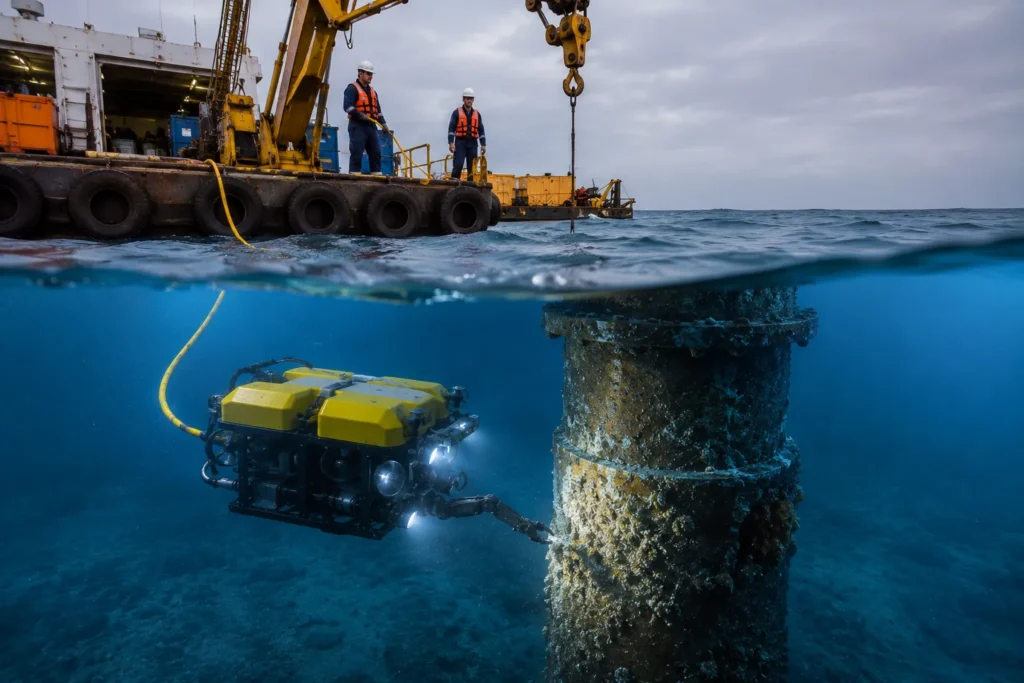
Underwater infrastructure requires precise inspections to ensure safety, performance, and long-term reliability. ROV Inspections have become one of the most effective tools for collecting accurate underwater survey data. Remotely Operated Vehicles (ROVs) allow engineers, marine contractors, and survey teams to inspect submerged assets without exposing divers to unnecessary risks.
The global underwater inspection market continues to expand as offshore energy, marine construction, and coastal infrastructure projects increase. According to industry data, offshore wind capacity exceeded 75 GW globally by the end of 2024, creating growing demand for accurate underwater surveys. Traditional diver inspections remain valuable, but ROV technology delivers higher consistency, greater coverage, and detailed digital records.
We have observed that modern ROV systems equipped with high-definition cameras, sonar imaging, and positioning systems can identify defects that may otherwise remain undetected. This capability helps project teams make informed decisions while reducing operational downtime. From bridge foundations to offshore platforms, ROV Inspections provide reliable data that improves survey accuracy and supports better asset management.
Why Accuracy Matters in Underwater Surveys
Accurate underwater surveys directly influence maintenance planning, structural assessments, and project costs. Even small measurement errors can lead to expensive repairs or delayed construction schedules. Engineers rely on precise survey information to evaluate structural conditions and determine corrective actions.
Modern marine infrastructure faces constant exposure to currents, corrosion, sediment movement, and biological growth. These conditions make regular inspections essential. In our experience, inaccurate survey results often create uncertainty that increases project expenses and operational risks. See how we help with The Future of Underwater Construction.
Common Challenges in Traditional Underwater Inspections
Traditional inspections frequently encounter visibility limitations, weather disruptions, and human observation inconsistencies. Divers may face restricted bottom time, particularly at greater depths. These factors can reduce data quality and limit survey coverage.
ROV systems address many of these challenges by operating continuously in difficult environments. They can access confined spaces, inspect deeper structures, and collect consistent visual records. This capability significantly enhances survey reliability while reducing dependence on environmental conditions.
How ROV Technology Enhances Survey Precision
Advanced ROV platforms combine multiple technologies to capture detailed underwater information. High-definition cameras provide clear imagery, while multibeam sonar systems generate accurate three-dimensional models of underwater structures.
Many commercial inspection ROVs can operate at depths exceeding 300 meters. Integrated navigation systems maintain positional accuracy within a few centimeters. This level of precision enables engineers to compare inspection results over time and identify structural changes.
Key Features That Improve Accuracy
The following technologies contribute to higher survey accuracy:
- High-definition video recording.
- Real-time image transmission.
- Multibeam sonar mapping.
- Laser measurement systems.
- GPS-linked positioning support.
- Digital data storage and reporting.
- Automated inspection route tracking.
These tools create comprehensive inspection records that support engineering analysis and regulatory compliance. We regularly see projects benefit from improved decision-making when detailed digital inspection data is available.
Applications of ROV Inspections Across Marine Industries
Marine industries increasingly depend on ROV Inspections to evaluate critical underwater assets. Offshore energy facilities, ports, bridges, dams, and pipelines all require accurate condition assessments.
In offshore wind projects, ROVs inspect turbine foundations, scour protection systems, and subsea cables. Port authorities use ROVs to assess quay walls, pilings, and navigation structures. Water utilities deploy them to inspect reservoirs and intake systems.
Industry Benefits of ROV Surveys
| Application Area | Inspection Focus | Accuracy Benefit |
|---|---|---|
| Offshore Wind | Foundations and cables | Detailed structural mapping |
| Bridges | Piers and footings | Early damage detection |
| Pipelines | Corrosion and defects | Precise condition monitoring |
| Ports | Pilings and seawalls | Comprehensive visual records |
| Dams | Structural integrity | Improved risk assessment |
| Water Facilities | Intake structures | Accurate maintenance planning |
Industry studies indicate that digital underwater inspections can reduce repeat survey requirements by up to 30%. Better data collection improves maintenance scheduling and lowers operational disruptions.
Data Collection and Reporting Advantages
One of the strongest advantages of ROV Inspections is the ability to generate detailed digital records. Every inspection can be recorded, archived, and reviewed later by engineers and stakeholders.
Advanced software converts collected information into measurable datasets. Survey teams can create three-dimensional models, annotate defects, and compare historical inspection records. This process supports predictive maintenance strategies and long-term asset management programs.
Supporting Better Engineering Decisions
Accurate reporting allows project managers to prioritize repairs based on actual structural conditions. Instead of relying on assumptions, teams can use measurable evidence to guide maintenance investments.
We have found that detailed ROV survey reports improve communication among engineers, contractors, and asset owners. Clear documentation also helps meet regulatory requirements and simplifies future inspections.
Conclusion
ROV Inspections continue to transform underwater surveying by delivering greater precision, consistency, and efficiency. Advanced imaging systems, sonar technology, and accurate positioning tools enable survey teams to collect reliable data in challenging underwater environments. These capabilities reduce uncertainty and improve maintenance planning across marine industries.
As underwater infrastructure expands, the demand for accurate inspections will continue to grow. ROV technology provides a practical solution for obtaining detailed survey information while minimizing operational risks. By improving data quality and creating comprehensive digital records, ROV inspections help organizations make informed decisions that support safer and more efficient asset management.